


Know Your Combs: The Big Five
Posted by Cool Blades | 9th Jun 2026


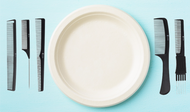
When you're first starting out in hairdressing, one of the best parts is buying your kit. A pair of cutting and thinning scissors, a set of brushes, and a collection of combs. Chances are you'll choose one comb out of the set and the rest will remain as good as the day bought them because you have NO IDEA what the rest are for apart from combing the hair out of your round brushes.
Of course you may find that you'll never have a use for them if you don't provide certain services, but as least you'll be a little wiser is the occasion arises!
This one is pretty straight forward. They come in various sizes to accommodate to different lengths and strengths of hair. Usually they have one half of narrow-spaced teeth and the other half wide-spaced. The former for better control of the hair which saves the latter for thicker, coarser hair that's too stubborn to glide through narrow teeth. A cutting comb can be used for cutting, sectioning and detangling and is every hairdresser and barber's go-to tool.
Generally larger in size and with extra wide teeth, often kept at the backwash (or in our showers) to detangle hair or comb conditioner and treatments through lengths and ends. Even though there are now many detangling brushes on the market, it is advised that a detangling comb is significantly gentler on the hair and scalp as the wide teeth make it easier to avoid snagging.
These are usually used to help seperate hair - especially curly or afro hair. Pick combs or prong combs can be used to distribute hair volume evenly by lifting the hair at the root without the hair frizzing which is why they are particularly useful on afro hair because they can help maintain curl structure. Pick combs are also handy for distrubuting volume through backcombed hair from underneath without compromising the set style.
A firm favourite for applying highlights, the pintail comb helps seperate hair into fine sections when weaving hair into foils. Pintail combs can comb with a thicker plastic prong or a finer metal prong - the latter used for more precise hair colouring work. The comb itself is made up of narrow spaced teeth which can be used to tease and backcomb hair towards the root for more technical colour work which requires colour blending such as balayage.
A taper or barber comb, true to the name, is predominantly used by barbers and those who do a lot of clipper work. Like the cutting comb, it is split into two different teeth spacings but the main difference is that it is designed with taper work in mind. The width of the comb is often narrower on one side which makes it easier to cut closer to the scalp when scissor over comb cutting.
All combs come in all different shapes and sizes, but as with anything in the creative industry, the tools you use often come down to preference and what works best for you. Similarly, all hair brushes are made differently and you may prefer one type over another. As long as you get the desired result, it doesn't matter what you use.